Workspace policies
Set an organization baseline, add stricter member overrides, and verify what the installed CLI can enforce.
On this page
Policies configure workspace behavior for connected devices. Owners, administrators, and security managers can manage policies. Start in observe mode, validate the intended matches on a test device, and check the actual assistant adapter before relying on denial.
Choose a mode
| Mode | Current CLI behavior |
|---|---|
observe | Does not deny based on workspace policy; capture and heuristic findings continue |
advisory | Emits a warning to stderr for a matching policy condition |
enforce | Produces a deny decision; a native blocking response is emitted for Claude Code and Codex PreToolUse only |
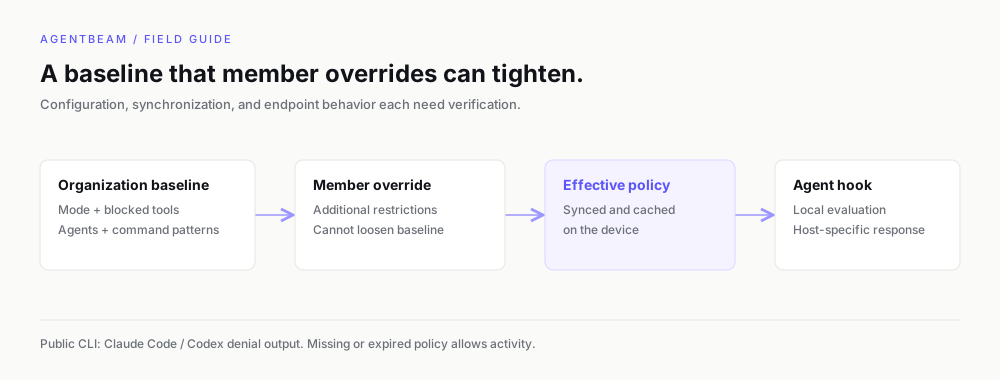
For Cursor, Copilot CLI, Gemini, and other adapters, a deny decision currently produces a stderr note that enforcement is not wired. It is not a verified block in those hosts. Missing, unreadable, or expired cached policy allows activity; this is not a fail-closed containment boundary.
Set the organization baseline
Open Policies and edit the organization policy. Select a mode, blocked tools, disabled agents, or blocked command patterns. Save the change and note the resulting policy version.
The UI also exposes structured rule rows, including command/argument conditions and block/alert actions. The public CLI evaluator currently reads the baseline blockedTools, disabledAgents, and blockedCommandPatterns fields; it does not evaluate the dashboard's structured-rule list. Verify compatible client support before relying on a structured rule.
Add a stricter member override
Select a member in the overrides section. Overrides can add restrictions or choose a stricter mode; they cannot loosen the organization baseline. Clearing an override returns the member to the baseline rather than disabling the organization's policy.
Synchronize and test
beam whoami
beam sync
The collector normally polls every 60 seconds for enrolled devices. The hook evaluates cached policy locally, so an already-cached policy can be read while the collector is unavailable. An expired bundle allows actions instead of trapping an offline user.
Test a harmless matching action in the intended assistant, then verify its response and audit/activity evidence. A dashboard policy version is configuration evidence; it is not proof that every endpoint has synchronized or denied a call.
Separate policy from detection
Custom scan rules add findings and do not automatically create blocking rules. A reviewed finding does not approve future execution. Native MDM profiles configure device settings through a different management channel; do not use agent policy as a substitute for OS enrollment or isolation.